Brussels – In the end, the go-ahead for the renewal of sanctions against Vladimir Putin’s Russia came without any major fuss, without any member state (read: Hungary) vetoing it and causing the process to falter. It will be back in six months, while the High Representative would like to have the 16th package of restrictive measures ready by February 24, on the third anniversary of the invasion of the former Soviet republic. The EU foreign ministers also approved the suspension of the facilitated regime for diplomatic visas for Georgian officials in an attempt to strike a blow at the authorities in Tbilisi without harming the pro-European aspirations of the population.
Out of danger (for now)
The green light at the Foreign Affairs Council meeting today (Jan. 27) after a brief political “case” that saw Hungarian Prime Minister Viktor Orbán threaten a veto on the renewal of restrictive measures against Moscow. A veto that would have risked breaking the bank, making disappear in one fell swoop the entire sanctions regime painstakingly put in place by the Twenty-Seven over the past 35 months of the war (even though the first sanctions date back to 2014, when Russia unilaterally annexed Crimea and supported separatists in the Donbas), codified in 15 packages adopted, and renewed, with the unanimity of the chancelleries.
The measures currently in place will therefore be extended by another six months, that is until 31 July. This is a wide spectrum of sectoral measures, including restrictions on trade, finance, energy, technology and dual-use goods (civilian and military), industry, transportation, and luxury goods, but also on imports of energy products (especially hydrocarbons) and Russian lenders’ access to the international financial system (the Swift), among others. The EU High Representative for Foreign Policy Kaja Kallas, who chairs the Foreign Council, welcomed today’s decision, reiterating for the umpteenth time that “Russia must pay for the damage it is causing” in Ukraine.

In this way, the infamous “extra profits” from the immobilised Russian capitals (i.e., those Central Bank of Moscow funds—amounting to over 200 billion euros—currently frozen in the jurisdiction of the Twenty-Seven, serving as “cash” for the maxi-loan decided last summer from the G7 countries), have also been secured (at least for the next six months). Brussels set up the mechanism in September, while the first 3 billion tranche was sent to Kyiv three weeks ago.
The “guarantees” to Hungary
The threats from the Magyar prime minister had kept Brussels on tenterhooks all weekend, as last Friday (Jan. 24), the ambassadors of the Twenty-Seven had been unable to find an agreement on the renewal of the sanctions regime to be submitted for approval to the ministers of the member states, who therefore had to discuss it this morning.
Budapest had demanded guarantees on gas supplies to avoid imposing its veto. It recently raised its voice (along with Robert Fico’s Slovakia) following Kyiv’s decision not to renew contracts with Gazprom for Russian methane transit through Ukraine.
Such assurances came today in the form of a statement of “energy solidarity” with landlocked countries signed by the European Commission and the High Representative. In the document—which lacks binding legal force—the EU executive recognizes that “the integrity of the energy infrastructure supplying EU member states is a security issue” for the entire Union and states that it expects “all third countries to respect it”, saying it is ready to “continue discussions” with Kyiv “on the supply of gas to Europe through the pipeline system in Ukraine,” and announcing the adoption of necessary measures “to protect critical energy infrastructure,” from power cables (under attack again in the Baltic) to oil and gas pipelines.

In short, little more than a sop to the Hungarian government (as Kallas herself seemed to confirm to reporters), which allowed Budapest to save face and retrace its steps without derailing the entire twelve-star sanctions system. Over the weekend, incidentally, Ukrainian President Volodymyr Zelensky also opened up to the possibility of transiting Azerbaijani gas through his country in the direction of EU states, a move he had previously ruled out because, he said, even that sold from Baku is Russian gas.
The suspension of Georgian diplomatic visas
Foreign ministers also decided today the suspension of certain parts of the visa facilitation agreement between the EU and Georgia to target diplomats and officials from the Caucasian country, including representatives of national and regional governments and parliaments and high courts. “The decision was adopted today,” Kallas said after the meeting, adding that “it is now up to the member states to implement it in accordance with their own legal systems.”
This is basically a political move (on which Brussels has been working since last month), since many of the people potentially affected by the measures probably have other passports, but it signals a willingness to hit the Georgian authorities without harming the population, who will continue to benefit from the facilitated visa regime stipulated in 2011 and updated in 2017.

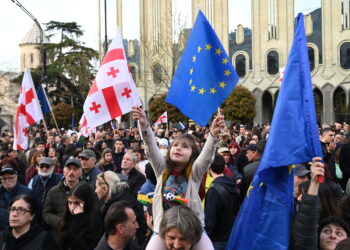
Protesters outside the Tbilisi Parliament on December 29, 2024 (photo: Giorgi Arjevanidze/Afp)
In the crosshairs of the Twenty-Seven are mainly the top leadership of Georgian Dream, the ruling party in power since 2012, held responsible for the democratic retreat of Tbilisi—which is moving ever further away from the EU (to whose membership it is constitutionally bound) and getting closer to the Kremlin orbit—and the violent crackdown against peaceful protesters, who have been protesting continuously on the streets of the capital and major cities for two months now, as well as against independent journalists such as Mzia Amaghlobeli, imprisoned for 15 days and currently on hunger strike.
But still, Hungary confirms itself as the EU’s black sheep. In the very hours when Foreign Minister Péter Szijjártó was at the Council, Orbán welcomed to Budapest the Speaker of the Georgian Parliament Sasha Papuashvili, reiterating full support for the pro-Russian government in Tbilisi, described as “pro-peace,” against “the attacks by Brussels and the Soros network.”
@PM_ViktorOrban reaffirmed Hungary’s strong support for Georgia in its disputes with Brussels during his meeting with @shpapuashvili, Chairman of the Georgian Parliament, at the Carmelite Monastery. Beyond political cooperation, the leaders discussed economic and energy… pic.twitter.com/JLkYbPcfBm
– Zoltan Kovacs (@zoltanspox) January 27, 2025
The reference is to the Hungarian-born U.S. financier George Soros, who has always been disliked by the Magyar leader and often pointed to as a sort of obscure puppet master of what Fidesz propaganda describes as the pro-war globalist elite.
English version by the Translation Service of Withub