Brussels – The showdown in the debate on carbon emissions in Europe is now imminent. Tomorrow, Wednesday 10 June, the European Commission will discuss the ETS revision, the system which regulates the CO₂ emissions trading market. Against this backdrop, Confindustria is seizing this final opportunity to make its voice heard. Its stance remains a genuine “alarm call“, a final appeal to the European Commission for action on the system through “a thorough review” of the mechanism. Otherwise, the employers’ association warns, “we will be heading towards deindustrialisation, which Europe cannot afford.”
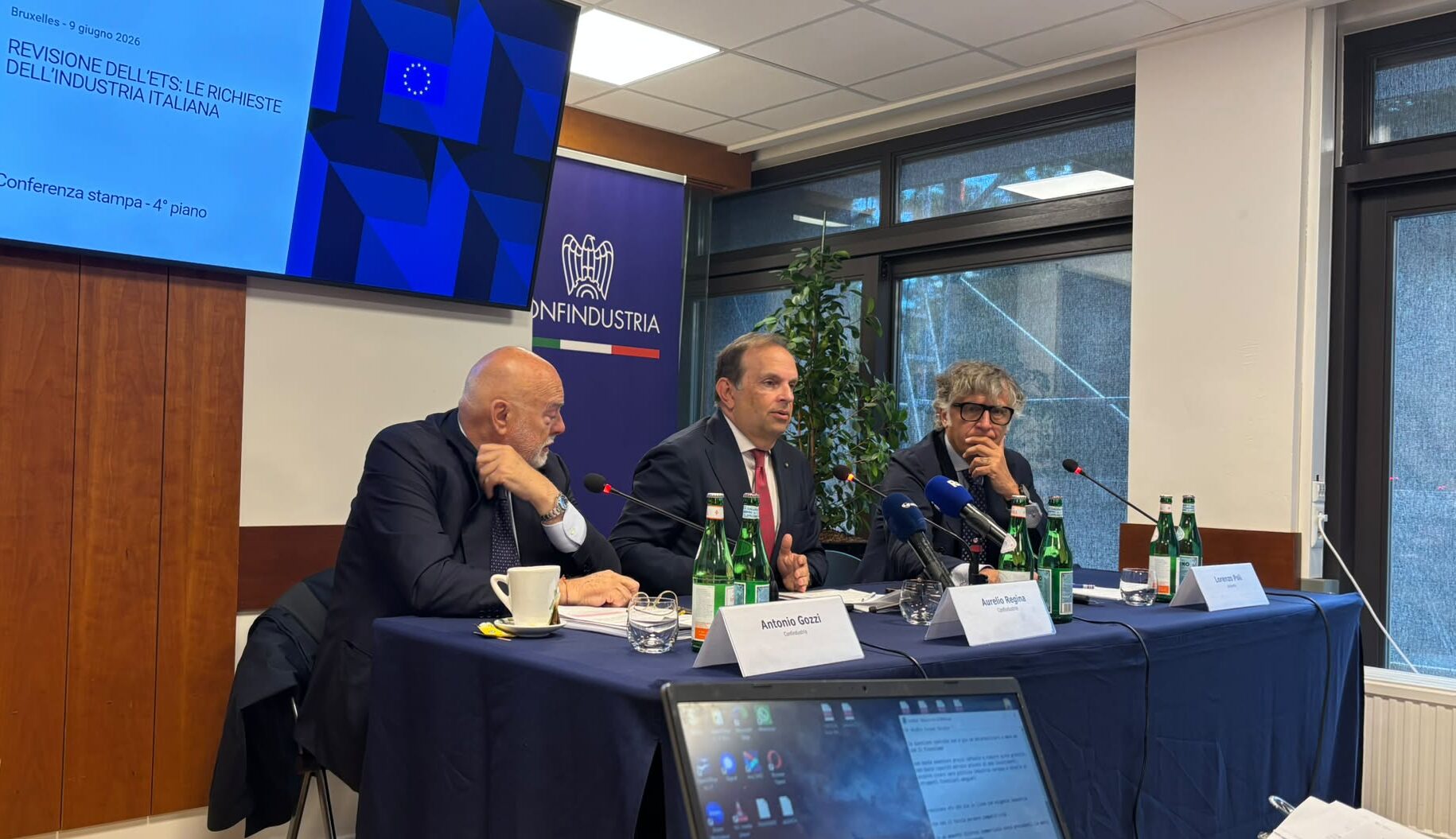
Representing Confindustria in Brussels are Aurelio Regina, Vice-President for Energy, Antonio Gozzi, Special Advisor to the President on European Strategic Autonomy, the Mattei Plan, and Competitiveness, and Lorenzo Poli, President of Assocarta. The three met at Confindustria’s headquarters in Brussels to continue their campaign ahead of the decisive meeting with the European Commission.
As a lengthy debate on the future of the ETS draws to a close, the European Union finds itself at a crossroads. On the one hand, there is a need to accelerate decarbonisation, which the European Commissioner for Climate Action, Wopke Hoekstra, considers increasingly urgent. He has, however, already hinted at a more gradual approach to phasing out free allowances, giving businesses more time to adapt to the green transition. On the other hand, pressure is mounting from industry. It is calling for consideration of the “technically and economically unsustainable efforts” demanded of companies at a particularly complex time for the European economy.
Aurelio Regina is the first to speak and immediately sets the record straight: “We, as the Italian industry, have no intention of halting the ecological transition or dismantling the European mechanisms for reducing emissions. On the contrary, quite the opposite.” However, he stresses, the revision of the ETS must be “far-reaching” and “compatible with the real needs of industry.”
“It would be very serious if the outcome were merely a few half-measures or minor tweaks,” he warns. “We need a review that addresses the fundamental mechanisms of the system.” A need made all the more urgent by the international context, marked by trade tensions and growing competitive pressure from China: “Chinese goods are flooding into Europe.”
Confindustria points out that the call is not coming only from Italy. “We are at a historic juncture where this is truly a crucial step. The review process is being strongly called for not only by our country, but by a growing number of Member States.” For Regina, the moment is decisive: “The review must be carried out now. In ten years’ time, there may be very little left to act upon.” He adds that any changes must, however, be consistent with the objectives of the European single market and with safeguarding industrial competitiveness. “We cannot ask for efforts that are technically and economically unsustainable, because for many sectors that would mean dying or throwing themselves off a cliff.”
Regina and Gozzi have a particularly busy schedule. This afternoon, representatives from Confindustria will meet with senior officials from the European Commission to present a package of 10 proposals ahead of the review of the ETS. Among the key demands is a halt to the reduction in free allowances for ETS sectors “until the geopolitical situation stabilises.”
According to Confindustria, measures such as free allowances and compensation for indirect costs remain essential to support the industrial transition and prevent decarbonisation from leading to the relocation of production. The issue of the growing financialisation of the ETS market is also central. Regina points out that the cost of CO₂ has risen from 6–7 euros per tonne in 2017 to 80 euros per tonne today, with increasingly severe consequences for energy-intensive businesses. “As it stands today, the ETS system increases competitive imbalances,” Antonio Gozzi argues. “Action must be taken to reduce them without penalising the most virtuous sectors.” The president stresses that the cost of the carbon tax incorporated into electricity prices ultimately hits precisely those industries that have invested most heavily in decarbonisation.
Also on the table is the issue of the new benchmarks used to allocate free allowances, namely the reference parameters established by the EU to calculate how many CO₂ emission allowances are allocated free of charge to large industries. According to Confindustria, Brussels should set them at the median for European plants, at 50 per cent, or at least 30 per cent, compared to the current benchmark of 10 per cent. “Today, we are comparing companies operating within national energy systems that are completely different from one another,” Regina notes.
The College of European Commissioners will discuss the ETS review tomorrow and present an initial draft proposal. The comprehensive proposal to reduce CO₂ price volatility, mitigate the impact on electricity prices, and contain costs across industrial supply chains is expected to be presented on 15 July.
English version by the Translation Service of Withub