

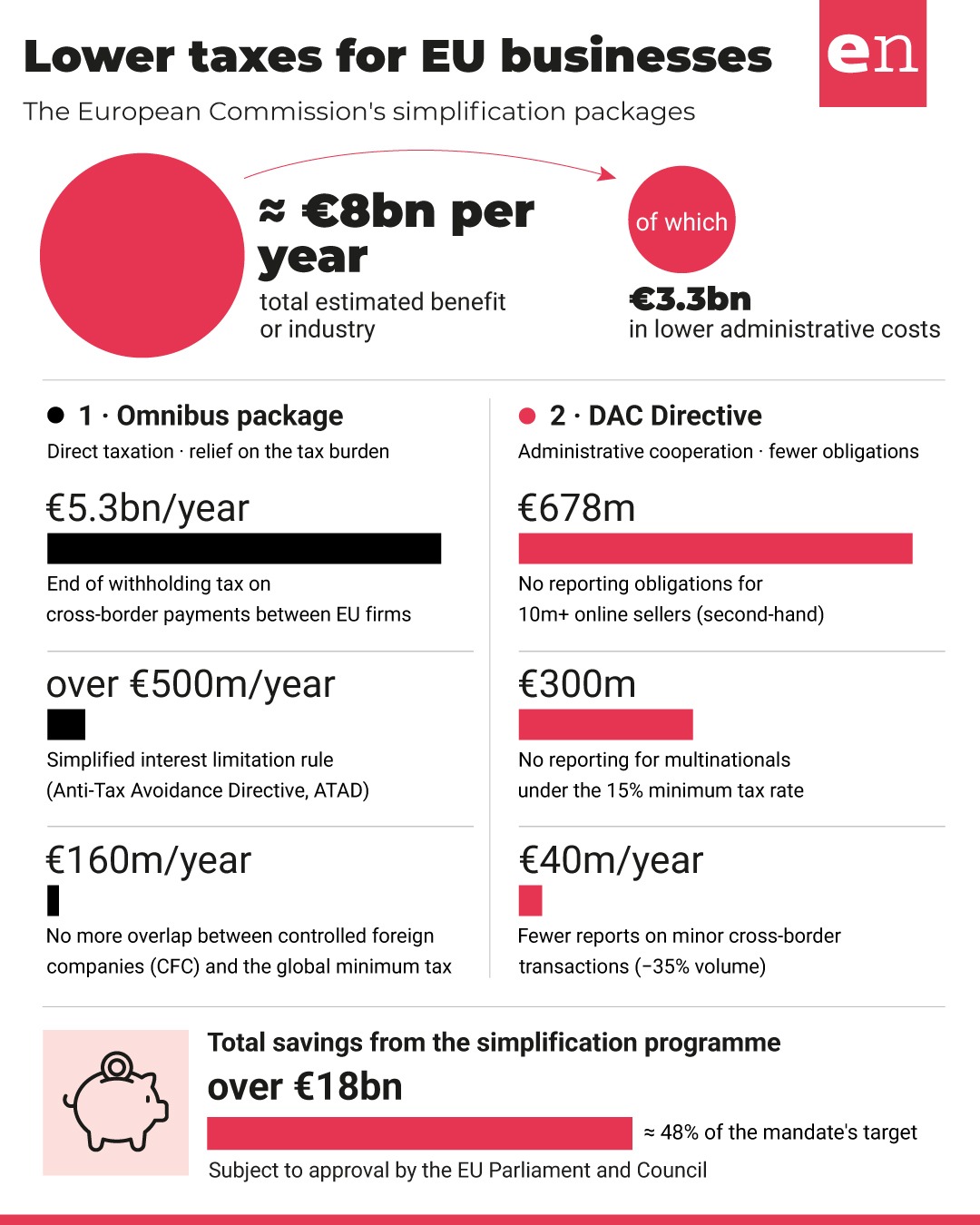
Brussels – Lower taxes for businesses. The European Commission’s major simplification drive, launched last year with the Omnibus packages, continues and amounts to an estimated eight billion euros a year windfall for industry through lower tax burdens and reduced administrative costs (3.3 billion euros). This is the combined effect of the Omnibus proposal on taxation and the revision of the Directive on administrative cooperation (DAC) presented today (24 June) by the European Commission.
The new Omnibus Act and the various tax relief measures
The omnibus bill on direct taxation introduces key measures, including an exemption from withholding tax on all cross-border payments of dividends, interest, and royalties between companies in the EU. The European Commission believes that by removing preliminary procedural requirements and simplifying refund procedures, the measure will facilitate financing, encourage investment, and strengthen competitiveness. This measure alone is expected to generate around 5.3 billion euros per year of savings and benefits for EU taxpayers.
Secondly, it proposes to remove unnecessary restrictions on genuine third-party and market financing, thereby facilitating business investment in the internal market. The omnibus bill is a boon to businesses because it simplifies the interest limitation rule in the Anti-Tax Avoidance Directive (ATAD) by removing the implementation options and making the de minimis threshold mandatory. These changes will lead to a reduction of over 500 million euros per year in administrative and compliance burdens.
It also proposes removing overlapping provisions between the Controlled Foreign Company (CFC) rules and the global minimum tax, reducing unnecessary complexity. This measure should enable businesses to save around 160 million euros a year in compliance costs.
Changes to existing rules: cuts of over one billion euros
The package presented today, Dombrovskis claims, “brings total savings from our simplification agenda so far to over 18 billion euros – almost half of our goal for this mandate.” Provided that the European Parliament and the Council of the EU approve it.



![La sede della BCE, a Francoforte [foto: European Central Bank]](https://www.eunews.it/wp-content/uploads/2025/11/eurotower-350x250.jpg)