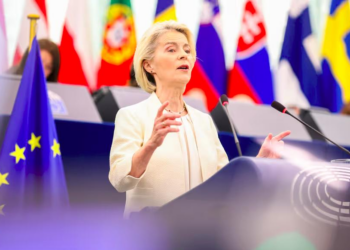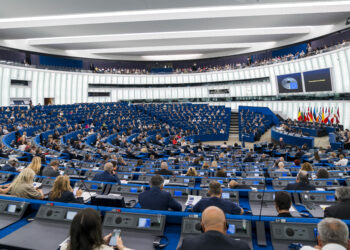

From our correspondent in Strasbourg – Widespread discontent. This is the reaction following the European Commission President, Ursula von der Leyen, delivering her State of the Union address this morning (16 September) – the so-called SOTEU. There has been widespread discontent regarding both the priorities and the actions of the head of the European Commission over the past year, and political affiliation is largely irrelevant: criticism has come from both the right and the left.
In the debate following the SOTEU, the president of the European People’s Party (EPP), Manfred Weber, is perhaps the only one to consider himself satisfied. It may be that he shares the same political family as von der Leyen, as well as German nationality, but the fact remains that among the issues for which he thanked the Commission President were artificial intelligence – a technology to which “we must respond” – and “the EU Children’s Act” – designed to protect children from online risks – which is due to be presented tomorrow. “Elon Musk won’t like it, but that is probably precisely why we should do it,” Weber emphasised. The president then announced that he would “fight for a sensible reform of the ETS and to stop the ban on combustion engines,” because he believes that “we need innovation, not bans.”
Some of the harshest criticism came from Patriots for Europe (PfE). The MEP elected with the Lega, Paolo Borchia, described the speech as a “complete detachment from reality,” as well as “a long series of broken promises,” particularly in the industrial sector. Like Weber, Borchia also fears “over-regulation” and described the current situation as that of the “Titanic sinking while the passengers continue to dance – or, in this case, to applaud.”
The accusation of unfulfilled promises is also widespread amongst the European Conservatives and Reformists (ECR). The group’s co-chair, Patrick Jaky, pointed out that “a reduction in bureaucracy” had been promised, whereas “the number of civil servants has increased and new recruitment is now being announced.” “A new industrial strategy and lower energy prices” had also been promised, but the result is that “industry is collapsing and energy prices have risen by 100 per cent during her term in office,” Jaky emphasised that, rather than climate change, the problem to be tackled is youth unemployment. And then there is migration. “Europe has never been as weak as it is now,” he said, adding that if “von der Leyen intends to do something for young people, she must stop censoring the internet and provide people with jobs and security, especially women.”
The Europe of Sovereign Nations (ESN) group also struck a similar tone. “The state of the Union can be described as a situation characterised by the loss of borders and a loss of competitiveness, including on the economic front,” said the group’s co-chair, René Aust. The Frenchman focused primarily on the section dealing with the migration crisis in Ceuta, describing the situation as “truly dramatic” and commenting that “nothing is being done to resolve it.”
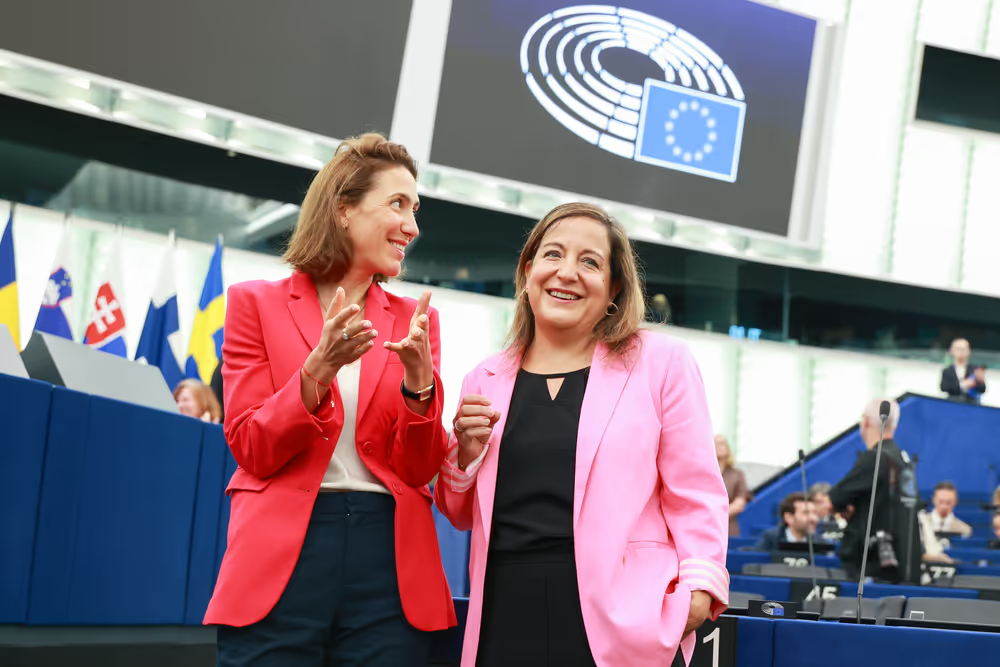
On the issue of migration, the president of Renew Europe (RE), Valeriè Hayer, has criticised the fact that Europeans have “lost faith in solidarity, partly due to Ms Meloni’s hypocrisy.” According to the chair of the liberal group, the top priority now must be a European law on climate resilience and risk management, as well as investing in “our capacity to innovate in disruptive technologies: green technologies, AI, data centres, biotechnology and quantum computing,” as “our sovereignty is at stake.” This also includes defending “our innovative businesses from unfair competition” and transforming “European public procurement into a genuine strategic weapon, as China and the United States do,” he added. Turning his attention to Canada and Prime Minister Mark Carney, who was present at the plenary session, Hayer called for “an economic security pact against commercial coercion.” Thus, “if Trump imposes tariffs, we respond collectively with tariffs; the same applies to China and anyone else,” he clarified.
According to the Greens MEP, Benedetta Scuderi – elected with the Green and Left Alliance – the speech “was very wide-ranging and very generous,” but “the facts are missing, because after almost two and a half years in office, the President is doing the exact opposite of what she said today.” Although the German MEP “spoke of the victims of the extreme heat (35,000 deaths this summer)”, it is “her parliamentary group and her party that continue to oppose every aspect of the transition and strike deals with the far right,” the MEP denounced. Her views were echoed by the co-chair of the Greens, Thierry Reitke, who announced that the group aims to push for an inquiry into the European Commission’s failure to deliver on the Green Deal, particularly in the wake of the wildfires that raged across Europe this summer.
The chair of the S&D Group, Iratxe García Pérez, called for the promotion of “competitiveness based on clean, secure, and affordable energy” and called for those who are “profiting from this specific energy crisis” to be taxed, because “the European project will not survive if our citizens cannot afford to live with dignity.” To this must be added the strengthening of “European housing legislation” and the adoption of “a law on quality work, with fair rules for the use of artificial intelligence in the workplace and for collective bargaining.” The Socialist politician recalled that a year ago the Commission had “called for the suspension of the trade component of the Association Agreement with Israel and for sanctions to be imposed” and, given that a year on there has been no action taken in this regard, “an arms embargo is now needed immediately.” The EU must also continue to defend Ukraine, including through “the confiscation of frozen Russian assets,” an issue which, according to the Spanish politician, needs to be “put back on the table.”