- L'Europa come non l'avete mai letta -
venerdì, 6 Novembre 2026
No Result
View All Result
  • en ENG
  • it ITA
Eunews
  • Politica
  • Esteri
  • Economia
  • Cronaca
  • Difesa
  • Salute
  • Agrifood
  • Altre sezioni
    • Cultura
    • Diritti
    • Energia
    • Green Economy
    • Finanza e assicurazioni
    • Industria e Mercati
    • Media
    • Mobilità e logistica
    • Net & Tech
    • Sport
  • Le Newsletter di Eunews
  • Invasione russa in Ucraina
  • Energia
  • Israele
  • Usa
    Eunews
    • Politica
    • Esteri
    • Economia
    • Cronaca
    • Difesa
    • Salute
    • Agrifood
    • Altre sezioni
      • Cultura
      • Diritti
      • Energia
      • Green Economy
      • Finanza e assicurazioni
      • Industria e Mercati
      • Media
      • Mobilità e logistica
      • Net & Tech
      • Sport
    No Result
    View All Result
    Eunews
    No Result
    View All Result

    Home » Non categorizzato » Pivotal days for biofuels – ActionAid: “Risk an unsatisfactory solution”

    Pivotal days for biofuels – ActionAid: “Risk an unsatisfactory solution”

    After the European Commission’s counsel in October, this week Parliament is discussing modifications to the directives in question. There are many discrepancies and they risk nothing coming of it.

    Redazione</a> <a class="social twitter" href="https://twitter.com/eunewsit" target="_blank">eunewsit</a> di Redazione eunewsit
    9 Luglio 2013
    in Non categorizzato

    After the European Commission’s counsel in October, this week Parliament is discussing modifications to the directives in question. There are many discrepancies and they risk nothing coming of it.

    The debate on biofuels has reached a bifurcation after years of involving NGO’s, public institutions, think tanks and citizens. Modifications of the two directives created in 2009 to regulate production and consumption are

    A rapeseed cultivation
    A rapeseed cultivation

    being discussed in Brussels: the directive on renewable energy and the one on the quality of biofuels. The topic is key to the internal European strategy to battle climate change since the EU imposed an ambitious objective upon itself – to have substituted 10% of fossil fuels with renewable ones in the transport sector (those that produce 22% of gas emissions with global greenhouse effects) by 2020.

    Everyone agrees on the objective – the problem is how to reach them. The 1st step is to use first generation biofuels – the ones made from food products: rapeseed, palm oil, soy, oleaginous (biodiesel), cereal, brown sugar, beet sugar (ethanol). But efficiency of many of these is questionable.

    Mainly there are 2 problems.

    On one hand the calculations of actual emissions for which biofuels are responsible. Everyone knows you cannot consider only emissions associated directly with production. You must count indirect emissions as well, which are linked to change in destination of land used (Indirect Land Use Change – ILUC). Increasing the area cultivated is harmful to forests and other carbon-rich lands and has the complete opposite effect of the one desired: an increase in greenhouse gas emissions. According to studies, currently biofuels would cause emissions equal to that of adding between 14-29 million more cars on European roads by 2020.

    The social aspect is another factor being discussed. The majority of raw agricultural material used to produce biofuels is being imported from non-European countries. The old country doesn’t have enough land to sufficiently respond to the demands for biofuels: hypothesizing a limit of 5% of the first generation ones – they would need 21 million hectares (more than 2/3 of the Italian area). So the request for land, above all in Sub-Saharan African countries, continues to increase and Land Grabbing (hoarding land without permission from the people who live there and in violation of Human Rights) is increasing. Not considering the need for food products required to produce biofuels is provoking a consistent increase in food prices.

    So it’s no surprise that discussions concerning the procedures for legislative norms that must regulate this sector are heated! Until a few months ago European policy was not even being discussed. However in October 2012, the European Commission intervened (on the same renewable energy directive mandate) to try to find a solution to the issue of indirect emissions. Among the main objectives of the EU council is the proposal to draw the line at a 5% limit on using first generation biofuels with a target of 10%. In this way the Commission thinks they would be addressing the problem of increasing demand for food for fuel compared to dietary needs. But on the ILUC issue, the Commission refuses to insert amounts of indirect emissions in calculating the threshold defined by sustainability criteria – inasmuch as calculation methods don’t yet guarantee an exact quantification: instead an annual reporting on factors is sufficient.

    Pieno secco poveriThis proposal doesn’t satisfy environmentalists and humanitarian associations. “The proposal of a 5% limit – notes Roberto Sensi, ActionAid Policy Officer – is a positive sign but the cap proposed is slightly higher than the current average of European replacement which is around 4.5%.” To propose this ceiling, which means “wanting to limit a future risk that is actually already present:” in essence in the short term European countries can continue to use first generation biofuels beyond the limit that must be guaranteed for 2020.” Regarding not counting indirect emissions, even if a method doesn’t exist yet to calculate them exactly, “we should adopt a principal of precaution,” suggests Sensi. And thus: until there is an exact scientific theory, we can use the ILUC factor because “not counting it, one assumes that there are no indirect emissions and this is certainly wrong.”

    Another important milestone for the directives on the subject (that should make it to the plenary session in September) will occur in a few days when the European Parliament Committee on the Environmental will vote on the proposal of the European MEP, Corinne Lepage (Alliance of Liberals and Democrats for Europe). Her text tries to mediate between the need to make biofuel production sustainable and not jeopardize investments already made by companies. Lepage’s proposal introduces ILUC in counting emissions and foresees a sub-target even for electrical energy from renewable sources in the transport sector to encourage use. The vote in chamber is scheduled for July 11th but it is already well-known that the proposal will not likely pass. On the other hand, if the Socialists lean in this direction, there is a strong opposition above all from the part of the European People’s Party (EPP) MEPs, who presented amendments that would radically change the direction. “We risk an insufficient solution” warns Sensi: “If the EPP’s compromising proposal passes – he explains – it would be the equivalent of not doing anything because the structural principles are not touched.”Action aid fuel

    A borderline case, but in theory it could happen if the proposal discussed is modified so much, it forces Lepage not to sign. Also in this case it would mean blocking everything – warns ActionAid: in 2020 we would still need to discuss how to face a problem that by that date should have been – if not resolved – at least confronted.

    Lena Pavese
    Tags: ActionAid @enbiofueleurope

    Ti potrebbe piacere anche

    Il commissario per l’Energia, Dan Jørgensen, e il commissario europeo per la Difesa, Andrius Kubilius durante il briefing per l' incontro del primo dialogo europeo sulle raffinerie. Crediti: Commissione europea
    Difesa e Sicurezza

    L’UE spinge la produzione delle raffinerie, Jørgensen: “Diesel essenziale a economia e difesa”

    28 Ottobre 2026
    Foto dell'evento “Il futuro della mobilità in Europa: coniugare decarbonizzazione, competitività ed eccellenza industriale europea”. Crediti: Canali social della delegazione europea di Confindustria
    Industria e Mercati

    Auto, da Confindustria e PPE appello a neutralità tecnologica e carburanti alternativi

    1 Luglio 2026
    ricerca
    Economia

    7,3 miliardi l’investimento Ue su Horizon per competitività e talenti

    14 Maggio 2025
    La statua dedicata a Leonida, a Sparta
    Non categorizzato

    A smaller Europe

    18 Ottobre 2019
    Economia

    GDP up by 0.2% and employment up by 0.2% in the euro area

    6 Settembre 2019
    Politica

    Why Did Italy Fall out of Love with Europe?

    23 Luglio 2019
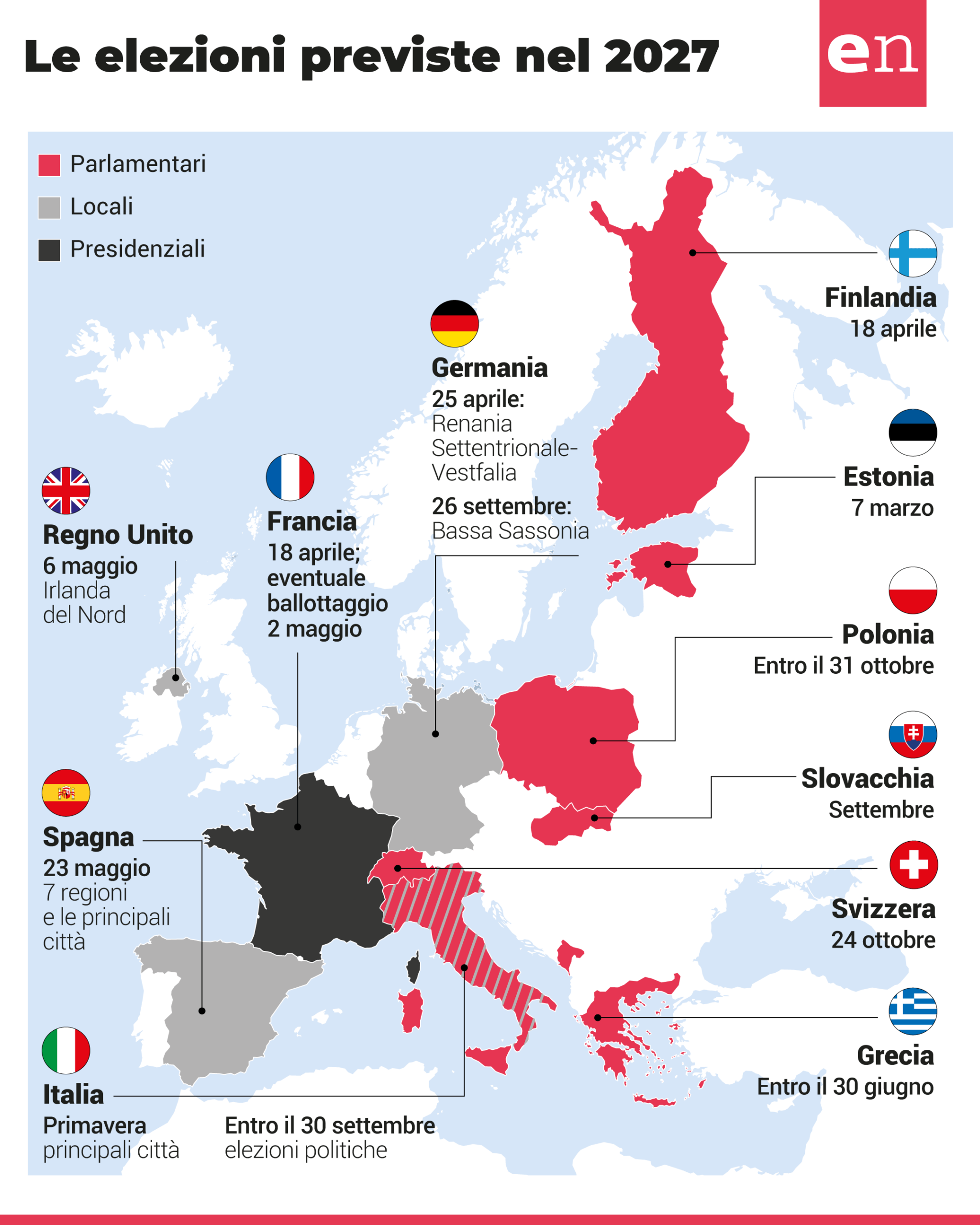
    Il prossimo anno ci saranno almeno 13 grandi elezioni in Europa

    TUTTI GLI EVENTI CONNACT

    Il Rapporto Draghi in italiano

    di Redazione eunewsit
    9 Settembre 2024
    CondividiTweetCondividiSendCondividiSendCondividi
    Made with Flourish
    La premier, Giorgia Meloni, il presidente del Consiglio europeo, António Costa, il presidente ucraino, Volodymyr Zelensky, preparazione della foto di famiglia del G7 del 16 giugno 2026 a Évian-Les-Bains. Source: Imagoeconomica via Governo.it

    Giorgia Meloni lamenta l’esclusione dai tavoli negoziali europei sulla guerra in Ucraina. Ma la posizione dell’Italia qual è?

    di Justus Lipsius
    6 Novembre 2026

    Stare alla finestra, promettere aiuti salvo poi dover fare i conti non solo con i propri alleati nazionali ma anche...

    Allarme bomba su oltre 20 voli in Europa. 5 Novembre 2026. Source: Photo de Defrino Maasysur Unsplash

    Allarmi bomba su oltre 20 voli, Tzitzikostas: “Ogni minaccia ai civili è inaccettabile”

    di Chiara Troiano @ChiaraTroiano
    5 Novembre 2026

    Il commissario ai Trasporti spiega che la Commissione "monitora" la situazione con gli Stati membri e l'Agenzia per la sicurezza...

    Bollette. Crediti: Chanhee Lee via Unsplash

    CESE: “L’UE ha bisogno di energia elettrica sostenibile, di alta qualità e a prezzi accessibili”

    di Iolanda Cuomo
    5 Novembre 2026

    In un parere adottato nella sessione plenaria di ottobre 2026, il Comitato economico e sociale europeo ha sottolineato che l'Unione...

    Cisgiordania. Crediti: David McLenachan via Unsplash

    Restrizioni ai prodotti delle colonie israeliane, Commissione UE: “Valutiamo nuovi obblighi sulle dichiarazioni d’importazione”

    di Iolanda Cuomo
    5 Novembre 2026

    E sulla proposta di Palazzo Berlaymont di sospendere l'Accordo di associazione UE-Israele, un funzionario della direzione Commercio spiega: "È ancora...

    • Editoriali
    • Eventi
    • Opinioni
    • Risultati Europee 2024
    • Chi siamo
    • Contatti
    • Privacy Policy
    • Cookie policy

    Eunews è una testata giornalistica registrata
    Registro Stampa del Tribunale di Torino n° 27

    Copyright © 2025 - WITHUB S.p.a., Via Savona 127/B, 20144 Milano
    Partita IVA: 10067080969 - Numero di registrazione al ROC n.30628
    Capitale sociale interamente versato 50.000,00€

    No Result
    View All Result
    • en ENG
    • it ITA
    • Politica
    • Esteri
    • Economia
    • Cronaca
    • Difesa e Sicurezza
    • Salute
    • Agrifood
    • Altre sezioni
      • Cultura
      • Diritti
      • Energia
      • Green Economy
      • Gallery
      • Finanza e assicurazioni
      • Industria e Mercati
      • Media
      • Mobilità e logistica
      • Net & Tech
      • News
      • Opinioni
      • Sport
    • Editoriali
    • Podcast / L’Europa come non l’avete mai ascoltata
    • Report Draghi
    • Risultati Europee 2024
    • Eventi
    • Le Newsletter di Eunews

    Attenzione