



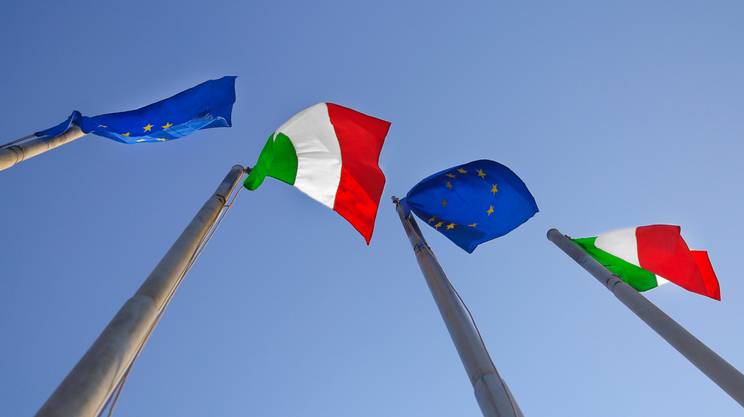
Italy has been depicted as Europe’s basket case, the ‘sick man’ or ‘soft belly’ of Europe—politically fickle and unstable, too large to fail but too difficult to save. This bias has overlooked how, historically, the country, on the frontier of the Cold War and geopolitically exposed at the center of the Mediterranean, has provided stability and positively influenced European integration.
The story of Italy falling out of love with the EU is uniquely tied to its history and circumstances, yet one should not underestimate the extent to which the country’s ills have actually become Europe’s new normal. Italy has pioneered the rise of euroskeptic politics and parties, which are now challenging the EU status quo across Europe. The transactionalist approach to the EU that Berlusconi embraced is also becoming a mainstream way for governments to interact with Brussels, regardless of their pro- or anti-EU preferences.
Read the full Mercator European Dialogue paper here.






![Da sinistra: il presidente del Consiglio europeo, Antonio Costa; il presidente dell'Ucraina, Volodymir Zelensky: la presidente della Commissione europea, Ursula von der Leyen [Bruxelles, 18 giugno 2024. Foto: European Council]](https://www.eunews.it/wp-content/uploads/2026/06/euco_ua260618-e1792173682649-120x86.jpg)
![[foto: Saverio De Giglio/imagoeconomica]](https://www.eunews.it/wp-content/uploads/2026/10/cpt-120x86.png)
![Caro bollette [foto: Marco Cremonesi/imagoeconomica]](https://www.eunews.it/wp-content/uploads/2026/05/Imagoeconomica_1787286-120x86.jpg)
