
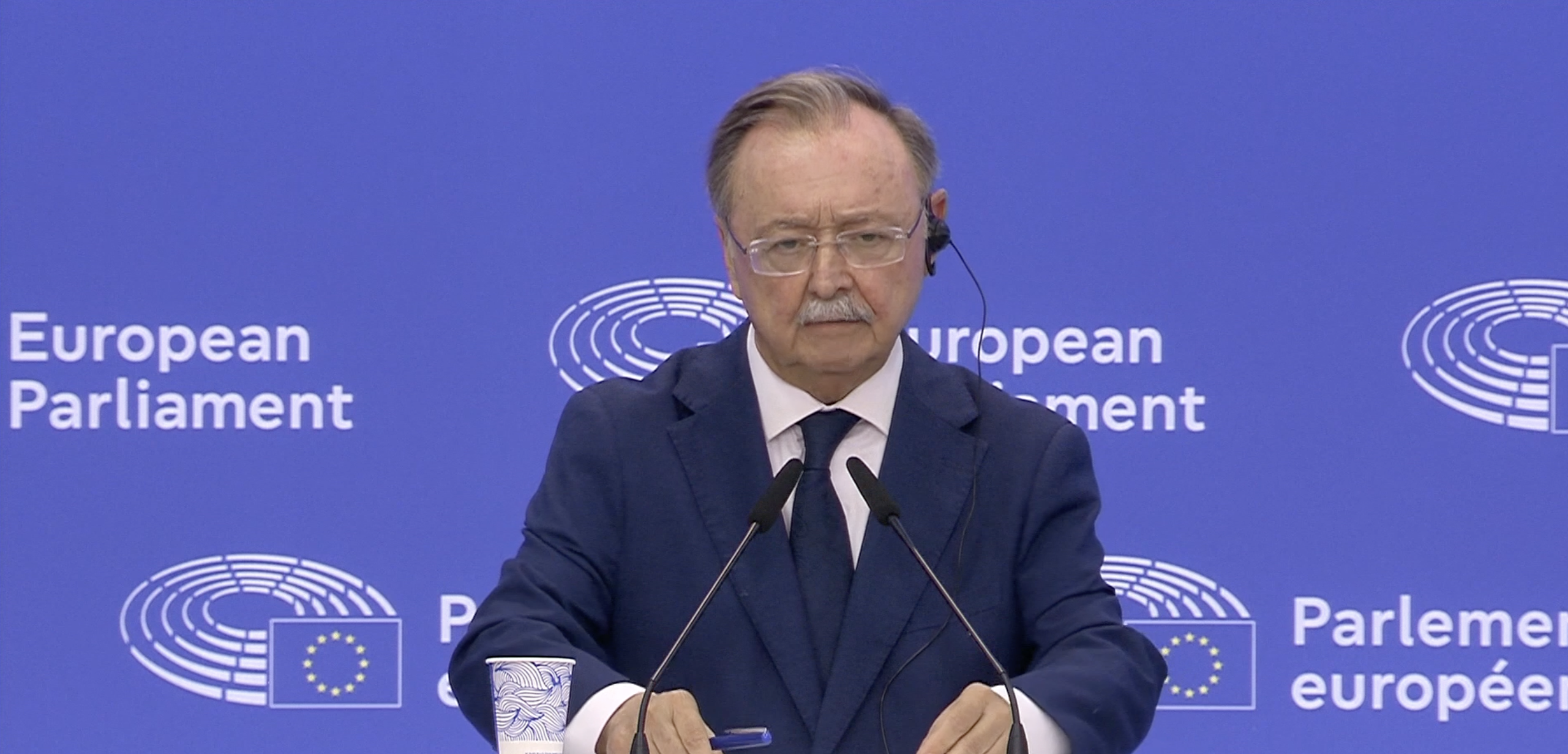
Brussels – “We call on the European Commission, the European Parliament and the European institutions to work together to ensure that Ceuta returns to normality as soon as possible.” This was stated today (8 September) by the mayor of Ceuta, Juan Jesús Vivas, who was visiting the European Parliament. Vivas was invited by the Chair of the European Parliament’s LIBE Committee (Civil Liberties, Justice and Home Affairs) MEP (EPP) Javier Zarzalejos to outline the current situation in the Spanish exclave. Here, between 30 and 31 July, around 60,000 migrants from Morocco have entered the country.
According to Vivas, the mayor elected on the ticket of the centre-right Partido Popular, “the only possible way” to return to normality is “the repatriation of all those who have arrived illegally and in large numbers.” He has therefore called for “a more visible European presence” at “our borders and in our towns,” through “Frontex, the European Border and Coast Guard Agency, and the European Asylum Agency.” The mayor also aims to secure the “financial support needed to carry out the infrastructure works required at the border,” so that control of the border remains in the hands of Spain and Europe, “and not a third country.”
The Spaniard emphasised that there are two measures that could change the current situation. The first is “the European Union’s explicit recognition of special treatment” for Ceuta and Melilla, the other Spanish exclave located on Moroccan territory. “We must take into account the conditions, difficulties, limitations, and threats that exist,” he reiterated. Secondly, he urged the adoption of “the European Pact on Migration and Asylum to their situation”—in particular, with regard to “the reception of unaccompanied minors”—when in fact the new regulations came into force on 12 June 2026 have been widely criticised as they risk subjecting minors to accelerated procedures and identification at border checkpoints, with possible measures restricting personal freedom or administrative detention. From the point of view of political support, Vivas is hoping for a “categorical and unequivocal statement from the European Parliament, making it clear that our southern borders, the only two land borders that Europe has in Africa, are European borders” and that Ceuta will become a member of the European Committee of the Regions, given that it does not yet have a permanent seat.
Unlike the Spanish Prime Minister, Pedro Sánchez, who did not explicitly hold Morocco responsible for the migration crisis, Vivas explicitly blamed him. For the mayor, this is “an absolutely unacceptable behaviour and a lack of respect, not only towards Ceuta or Spain, but towards the entire European Union.” According to Vivas, his responsibility cannot be ruled out because “it is impossible for a mobilisation of 80,000 people to take place without the Moroccan authorities being aware of it.” There are also reportedly “Spanish police reports which show, through images, some Moroccan customs officials directing people towards the border.” Finally, “this is not the first time that Morocco has used border controls and migratory pressure to destabilise our cities, to jeopardise our integrity, and to overload our migrant reception services,” he pointed out. After expressing his sympathy for the victims of the crisis—141 according to Sánchez’s estimates last week—the mayor concluded the press conference by stating: “Ceuta is a pressure cooker that could explode at any moment.”
English version by the Translation Service of Withub


![Da sinistra: il presidente del Consiglio europeo, Antonio Costa; il presidente dell'Ucraina, Volodymir Zelensky: la presidente della Commissione europea, Ursula von der Leyen [Bruxelles, 18 giugno 2024. Foto: European Council]](https://www.eunews.it/wp-content/uploads/2026/06/euco_ua260618-120x86.jpg)
![[foto: Saverio De Giglio/imagoeconomica]](https://www.eunews.it/wp-content/uploads/2026/10/cpt-120x86.png)