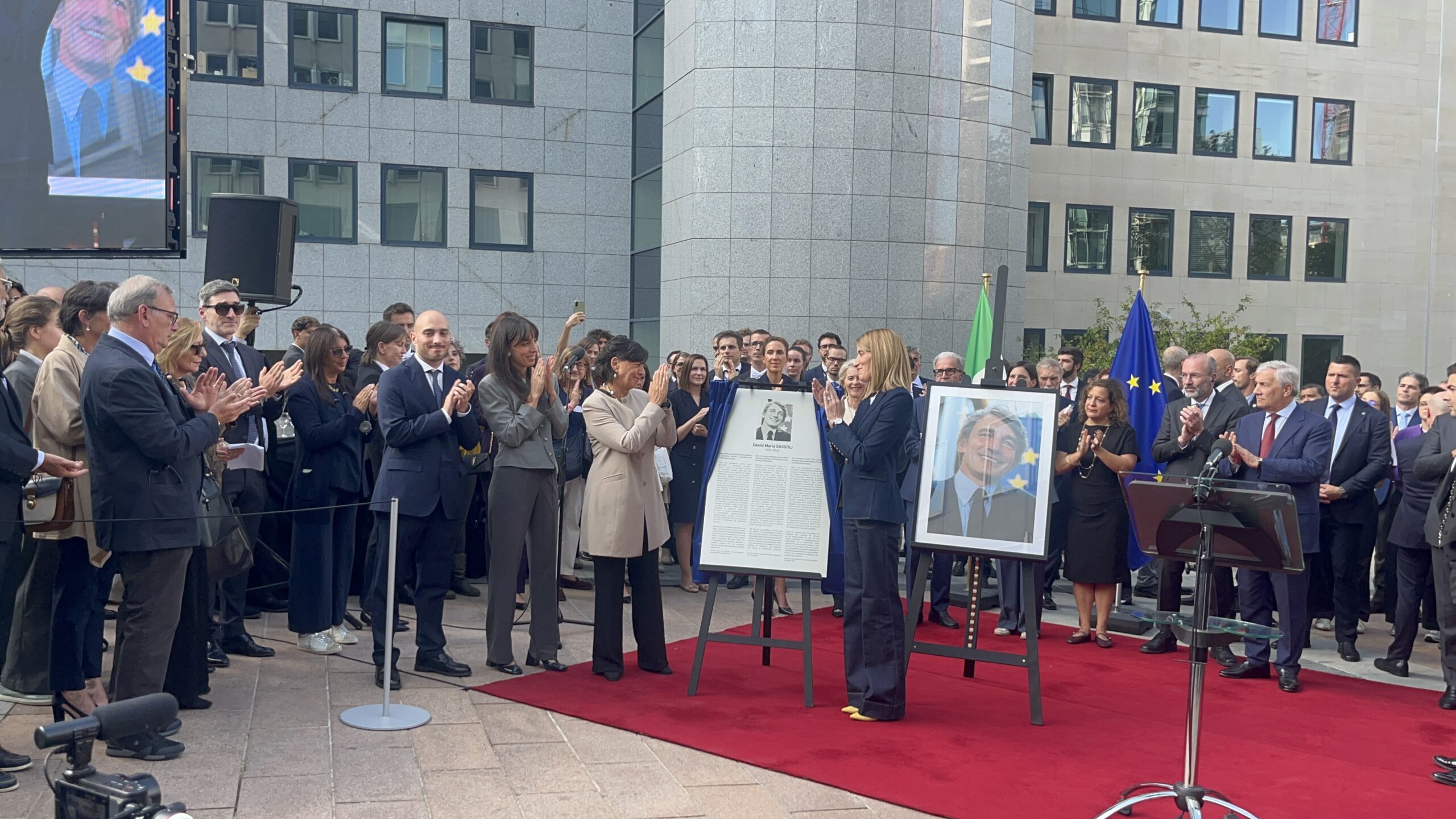
Brussels – From today, David Sassoli’s name “is not only associated with schools, public spaces, cultural and institutional venues, but also with a building of this European Parliament,” “the institution to which he chose to dedicate himself over 17 years ago, the place he proudly hailed as an indispensable seat of democracy and the direct representation of European citizens.” These were the words spoken in Brussels by Alessandra Vittorini, architect and wife of David Sassoli, after one of the European Parliament’s buildings was today (29 September) officially renamed in honour of the former President of the European Parliament.
During the official ceremony held at the Esplanade – the area in front of the European Parliament – Italy’s Ambassador to the European Union, Vincenzo Celeste, read out a message from the President of the Italian Republic, Sergio Mattarella. The President wished to pay particular tribute to his “leadership of the European Parliament during a period of extremely complex challenges in the Union’s recent history, such as the pandemic emergency.” As during the COVID-19 pandemic, when Sassoli was determined to find a way to keep the Parliament open and operational by utilising new technologies and holding meetings, including plenary sessions, online. Because “democracy cannot be brought down by the virus, because we are the only European institution elected by the citizens and we want to represent and defend them,” he maintained.
Similarly, in her opening address, the President of the European Parliament, Roberta Metsola, emphasised that at that time, while “the world was closing in and many found themselves even more alone,” Sassoli “opened the doors of the European Parliament in Brussels to women who had nowhere safe to turn,” because “for David, principles were not meant to remain mere words; they had to be translated into concrete actions.” The case mentioned by Metsola dates back to 2020, when Sassoli had made an agreement with the Brussels-Capital Region and made the European Parliament’s buildings available to accommodate the most vulnerable and the homeless, as well as distributing around a thousand meals a day to those most in need and to the healthcare workers assisting them.
Another moment in Sassoli’s story that Metsola highlighted was when “in 2021, well before the Russian invasion of Ukraine, Moscow banned him from entering Russia,” shortly before the invasion of Ukraine. The former journalist had been placed on a sort of “blacklist”, in response to the targeted sanctions adopted by the European Union against Russian citizens in March 2021. That ban was “a source of pride,” Metsola clarified.
Today, “the Parliament’s buildings are named after men and women who have helped Europe move forward: Simone Veil, Altiero Spinelli, Willy Brandt, and others,” explained the President of the European Commission, Ursula von der Leyen, adding that “this is exactly where David Sassoli belongs.” The building named in honour of Sassoli is the third to be named after an Italian, following the one in memory of Altiero Spinelli in Brussels and the one dedicated to Alcide de Gasperi at the Commission’s headquarters in Luxembourg. Among his many achievements, the President of the EU Commission was keen to highlight, above all, his role in Next Generation EU – the economic recovery fund created by the European Union to repair the damage caused by the COVID-19 pandemic. Von der Leyen recounted that in the early months of the pandemic, “I jotted down some figures on a paper tissue: the central idea of the recovery plan we were working on,” and to which “David immediately agreed.” Despite “all the difficulties of that period, the Parliament fast-tracked the NextGenerationEU process, giving the green light in just 57 days. The moment called for concrete action. And David answered that call,” she emphasised.
The Italian Minister for Foreign Affairs, Antonio Tajani, recalled having found himself “working alongside” Sassoli, despite their different political affiliations, “always with the same aim: to defend the institutions and defend Europe, because we believed in a Europe of values, and today this warning must not be underestimated.” Meanwhile, the secretary of the Democratic Party, Elly Schlein, emphasised her desire to “bridge the gap between the institutions and the people,” taking “Europe literally upon his shoulders, travelling to Fossoli with President von der Leyen and to the Greek islands at the height of the migration crisis, building bridges and opening the doors of the European Parliament during the pandemic.”
One of Sassoli’s most important legacies, however, was perhaps best illustrated by the former Prime Minister, Romano Prodi: the desire to foster greater unity amongst the institutions. In a speech entitled “A Europe that innovates, a Europe that protects and a Europe that is a beacon”, Sassoli had stated that “we believe that every country must apply its own rules and respect its own traditions, but it is up to Europe to ensure that every Member State can achieve these objectives,” calling for less fragmentation amongst the EU institutions and a more cohesive European policy.
David Sassoli was an Italian journalist and politician who was elected President of the European Parliament on 3 July 2019, succeeding Antonio Tajani. He held this office until his death on 11 January 2022 at the age of 65. To honour David Sassoli’s legacy, the Bureau of the European Parliament – comprising the President, the Vice-Presidents and the Quaestors – decided on 9 February 2026 to name the Treves building after the former President.
“Europe needs, above all, a new vision of hope – a vision that unites us, a vision that embodies our Union, our values and our civilisation, a vision that is self-evident to all Europeans and that enables us to come together,” Sassoli had stated in his final address as President of the European Parliament, while extending his Christmas and New Year wishes in December 2021. A message which, in today’s divided and polarised Europe, is more relevant than ever.