



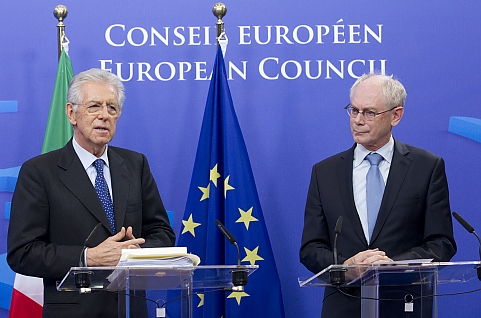
 After more than 26 hours of negotiating, the 27 countries of the EU came to an agonizing agreement on the new EU budget 2014-2020 on Friday afternoon. Much was written on the final results. Countries tackled the negotiations considering the immediate costs more than the future opportunities. In difficult economic times with tightened financial resources, the European budget could have compensated for the indispensible austerity program on a national level and become an economic venue and a multiplier of progressing initiatives.
The member states preferred to reduce the budget cut proposal, limiting it above all to current issues and considering the national contributions more of a cost than an investment. Italy wasn’t excluded. Governor Monti hailed with emphasis on the final agreement, calling attention to the fact that the country, a net contributor, would be able to reduce the net contribution, that is to say, the difference between that which it gives to the EU and that which it receives from the EU. We know why Prime Minister Mario Monti opted for this direction. In full election campaign swing, he didn’t want the European agreement to be criticized by his political adversaries. Moreover, other (all) countries acted in the same manner, using their own loss ratio as a compass. It is difficult to take a more constructive and idealistic position of other partners. Denmark itself obtained a refund, increasing a group of countries that already benefit from this questionable peculiarity. In this perspective, Italian diplomacy obtained an illustrious result. Yet, Italian behavior seems arguable to me for at least two motives. First of all, it offers the community “give and take” a reduced vision. The national contribution to the EU budget is not a cost but an investment. In the last 10 years didn’t Europe maybe allow thousands of young Italians to study abroad? To contribute new infrastructure to the country? To allow with its own commercial policy for hundreds of small and medium business in the North and South to also sell in world markets? To overlook the increasing loss ratio is a little like a shopkeeper who keeps his store clean but doesn’t sweep the snow off the sidewalk. Helmut Schmidt said one day that “today’s investments are tomorrow’s profits.” This is true for an individual, a family, a business, a country. No expense is really non repayable, neither for a person nor for an institution. It depends on the way in which it is decided, interpreted and used. Too often Italy, even outside the European boundaries, seems to forget this. I will come to the second controversial aspect of Italian behavior.
Europe enriched the country and changed its perspectives. It is not a trivial thing, neither from an economic point of view nor from a political one. Whoever pays more than he receives sits at the EU table with a weight, a role, a stronger influence than a country that, on the other hand, depends on Community funds. Talleyrand said: “Le meilleur moyen de renverser un gouvernement, c’est d’en faire partie” (The best way to make a government fall is to break it into parts). The same goes for Europe, naturally without thinking about wanting to make it fall, but rather influencing it. The Italian authorities distributed a chart during the assembly here in Brussels which brings to light that the Italian net contribution to the EU budget decreases from 4.5 billion annually in the 2007-2011 plan to 3.8 billion in the 2014-2020 plan. The objective was to highlight the Italian success. The same chart illustrates that the German net contribution increases in the same period from 8.4 to 10.6 billion Euros. Certainly the trend of the contributions is also a function of the evolution of national prosperity (growth) – the Italian one went down, the German one went up – but it is significant that Chancellor Angela Merkel didn’t complain about this situation yesterday. It is of little importance if Germany was also probably successful in its goal to limit national disbursements. Mrs. Merkel knows that the German contribution – provided it is not exaggerated and the country does not become the Zahlmeister (the official one who pays for Europe), is more of a political investment than an economic cost. She knows this situation reinforces her position in the Assembly of 27. Italy doesn’t seem to understand this. Italian diplomacy could argue that for a country burdened by debt, a reduction in the Italian contribution to Europe is a further step in recovering from public liability. However, I wouldn’t want it to be easier to deal with the Italian checks to the EU rather than on the support given to the lobbyists at home. A small annotation itself on this chart distributed Friday by the Italian government. The net contribution of a country in a community system has two variable functions: its contributions to the Community system and its ability to use European funds. More so, a net contributing country must be able to repatriate European money enough so that its net contribution will be low. In these weeks the government explained that in 2011 they were the most generous net contributor, forgetting to say that this result was also reflected by an inability to use European funds at its disposition.
Beda Romano
NB: From the frontline in Brussels (ex-GermaniE) and also on Facebook
For the original article click here

![Il ministro dei Trasporti, Matteo Salvini [Bruxelles, 5 dicembre 2024. Foto: Emanuele Bonini per Eunews]](https://www.eunews.it/wp-content/uploads/2024/12/salvini241205-350x250.jpeg)

![[foto: Bogdan Hoyaux. Copyright: CE - Service audiovisuel, European Union , 2026]](https://www.eunews.it/wp-content/uploads/2026/10/eu-inc-350x250.jpg)





![Il ministro dei Trasporti, Matteo Salvini [Bruxelles, 5 dicembre 2024. Foto: Emanuele Bonini per Eunews]](https://www.eunews.it/wp-content/uploads/2024/12/salvini241205-120x86.jpeg)

![[foto: Bogdan Hoyaux. Copyright: CE - Service audiovisuel, European Union , 2026]](https://www.eunews.it/wp-content/uploads/2026/10/eu-inc-120x86.jpg)
