- L'Europa come non l'avete mai letta -
lunedì, 20 Aprile 2026
No Result
View All Result
  • it ITA
  • en ENG
Eunews
  • Politica
  • Esteri
  • Economia
  • Cronaca
  • Difesa
  • Salute
  • Agrifood
  • Altre sezioni
    • Cultura
    • Diritti
    • Energia
    • Green Economy
    • Finanza e assicurazioni
    • Industria e Mercati
    • Media
    • Mobilità e logistica
    • Net & Tech
    • Sport
  • Newsletter
  • Invasione russa in Ucraina
  • Energia
  • Israele
  • Usa
    Eunews
    • Politica
    • Esteri
    • Economia
    • Cronaca
    • Difesa
    • Salute
    • Agrifood
    • Altre sezioni
      • Cultura
      • Diritti
      • Energia
      • Green Economy
      • Finanza e assicurazioni
      • Industria e Mercati
      • Media
      • Mobilità e logistica
      • Net & Tech
      • Sport
    No Result
    View All Result
    Eunews
    No Result
    View All Result

    Home » Non categorizzato » The European Union and Ukraine: Four lessons for the EU

    The European Union and Ukraine: Four lessons for the EU

    Rosa Balfour</a> <a class="social twitter" href="https://twitter.com/@RosaBalfour" target="_blank">@RosaBalfour</a> di Rosa Balfour @RosaBalfour
    25 Novembre 2013
    in Non categorizzato
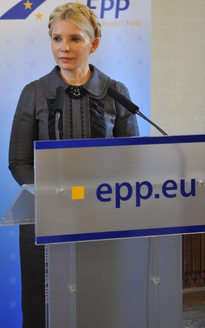
    Yulia Tymoshenko at an Epp's podium
    Yulia Tymoshenko at an Epp’s podium

    It looks like Yulia Tymoshenko will spend more time in prison. The Ukrainian parliament failed to ratify a set of laws which would have allowed her to receive medical treatment in Germany. By not doing so, the government effectively decided not to sign the Association Agreement and the Deep and Comprehensive Agreement (AA and DCFTA) with the European Union at the upcoming Eastern Partnership summit in Vilnius at the end of the month.

    This is a major blow for both Ukraine and the EU. For Ukraine, this was the best possible deal Brussels could have offered. For the EU, this marks a failure for the Eastern Partnership policy, which stepped up its engagement in the whole of Eastern Europe since 2009, but seems to have persuaded only Moldova and Georgia of the opportunity of this offer. What went wrong?

    Much of the explanation lies in the ambiguous relationship between Moscow and Kiev. It is somehow ironic that Russia emulated some of the methods used by Brussels and proposed the creation of a Eurasian Customs Union to those same countries which have been offered the AAs and DCFTAs. The two offers are not compatible. Belarus has always been on board; in September Armenia shocked the EU by switching to Moscow’s proposal; and now it is to be expected that Ukraine too will get closer to Russia.

    Of course, Moscow also pulled out its better know foreign policy tactics to ’persuade’ these countries to shift to its orbit, by threatening trade cuts or energy provision repercussions should Kiev sign the agreement with the EU. Ukraine has a precarious financial situation and a leadership which is more interested doing business and getting re-elected (presidential elections are due in 2015) than thinking about the long-term future of the country. So it looks like short-term gains have had the upper hand over long-term advantages.

    But could things have been dealt with different in the EU? Placing the blame squarely on Russia probably reflects much of what has been going on during the closed door meetings between the two presidents Yanukovich and Putin, but the EU should draw some lessons too on how to use its leverage and conditionality.

    First of all, the personalization of political relations around the figure of Yulia Tymoshenko was, quite simply, a mistake. She may be for many a revolutionary heroine, who is very close to the European leaders who are part of the European People’s Party family. But it is one thing to offer sympathy to an ally, quite another to address ‘selective justice’ by staunchly defending a single politician. The judiciary in Ukraine was dysfunctional even before the trial against Tymoshenko started, but there was very little said by the EU in those days on this matter. One lesson the EU should draw is that it should focus on reform of the state and avoid being drawn into disputes between political rivals in a country which is not famous for the moral standards of the ruling classes.

    The personalization of the situation in Ukraine also limited the EU’s room for manouevre and negotiation. Tymoshenko herself pleaded the EU and Ukraine government to sign the AA and DCFTA. But the EU cannot backtrack on the conditions set without losing its face. Focusing on qualitative reform would have given some space for interpretation and negotiation (the Ukrainian parliament passed one law on electoral reform of the three conditions set by the EU). This is too little, too late, but had there not been the overhanging Tymoshenko issue it could have been argued that at least some progress was made, however insufficient.

    Thirdly, the DCFTAs do not offer any immediate benefits or incentives to Ukrainians. In fact, in the first instance there are costs of adaptation, which the state, sectors of business and society would all have to pay. In all the neighbouring countries which are struggling not to go bankrupt, the EU has been unwilling to offer any concrete financial support or incentive to buy into approximating their rules to the new trade regime. With fissiparous politics, it would be hard even for a committed government to push for an agreement which in the short run bears more costs than advantages.

    The package that the EU has proposed to Ukraine is the best that will ever be on offer. Brussels is not about to launch a Marshall Plan towards its neighbours, despite the fact that these countries are becoming less, not more stable. This is not because the strategic challenge is not appreciated in European capitals. It is simply not appreciated in the same way. Some thinking among the European capitals on how to address the many challenges in the neighbourhood may be the fourth lesson to be drawn from these events.

    Rosa Balfour
    Ti potrebbe piacere anche

    Rumen Radev, ai tempi in cui era presidente della Repubblica bulgara [foto: imagoeconomica]
    Politica

    Bulgaria, alle urne vince il sospettato filo-russo Radev

    20 Aprile 2026
    Il presidente francese Emmanuel Macron, accompagnato dalla premier italiana Giorgia Meloni, dal primo ministro britannico Keir Starmer e dal cancelliere tedesco Friedrich Merz, arriva al Palazzo dell'Eliseo per una conferenza sull'iniziativa per la navigazione marittima nello Stretto di Hormuz il 17 aprile 2026 a Parigi, in Francia. Foto di Jeanne Accorsini/Pool/ABACAPRESS.COM. IPA Agency
    Politica Estera

    Hormuz riaperto, da Parigi i volenterosi pronti a missione pacifica

    17 Aprile 2026
    Seggi elettorali. Fonte: Sara Minelli via Imagoeconomica
    Politica

    Dopo Ungheria, Bulgaria, Cipro, Svezia e Lettonia: le elezioni nell’UE nel 2026

    17 Aprile 2026
    La commissaria europea al Mediterraneo, Dubravka Šuica, presenta il Patto Mediterraneo Piano d'Azione (17 aprile 2026). Fonte: EC - Audiovisual Service
    Difesa e Sicurezza

    Trasformare le sfide attuali in opportunità: l’UE presenta il piano d’azione per il Mediterraneo

    17 Aprile 2026
    Terroristi, fondamentalisti [foto: Carlo Carino/imagoeconomica, via IA]
    Politica Estera

    Il Medio Oriente preoccupa l’UE: “Occhi aperti sulla minaccia del terrorismo”

    17 Aprile 2026
    Inkyo Cheong e Maroš Šefcovic. Fonte: EC - Audiovisual Service
    Economia

    L’UE punta sull’Indo-Pacifico: nuovi passi con Seul e Tokyo su commercio digitale e difesa

    17 Aprile 2026

    TUTTI GLI EVENTI CONNACT

    Il Rapporto Draghi in italiano

    di Redazione eunewsit
    9 Settembre 2024
    CondividiTweetCondividiSendCondividiSendCondividi
    Made with Flourish
    Rumen Radev, ai tempi in cui era presidente della Repubblica bulgara [foto: imagoeconomica]

    Bulgaria, alle urne vince il sospettato filo-russo Radev

    di Emanuele Bonini emanuelebonini
    20 Aprile 2026

    Bulgaria Progressista (PB) ottiene il 44,5 per cento dei voti e conquista la maggioranza assoluta in Parlamento. Il vincitore avverte...

    Il presidente francese Emmanuel Macron, accompagnato dalla premier italiana Giorgia Meloni, dal primo ministro britannico Keir Starmer e dal cancelliere tedesco Friedrich Merz, arriva al Palazzo dell'Eliseo per una conferenza sull'iniziativa per la navigazione marittima nello Stretto di Hormuz il 17 aprile 2026 a Parigi, in Francia. Foto di Jeanne Accorsini/Pool/ABACAPRESS.COM. IPA Agency

    Hormuz riaperto, da Parigi i volenterosi pronti a missione pacifica

    di Giulia Torbidoni
    17 Aprile 2026

    Al vertice organizzato dai leader di Francia e Regno Unito, arriva e viene accolta con favore la notizia della riapertura...

    Seggi elettorali. Fonte: Sara Minelli via Imagoeconomica

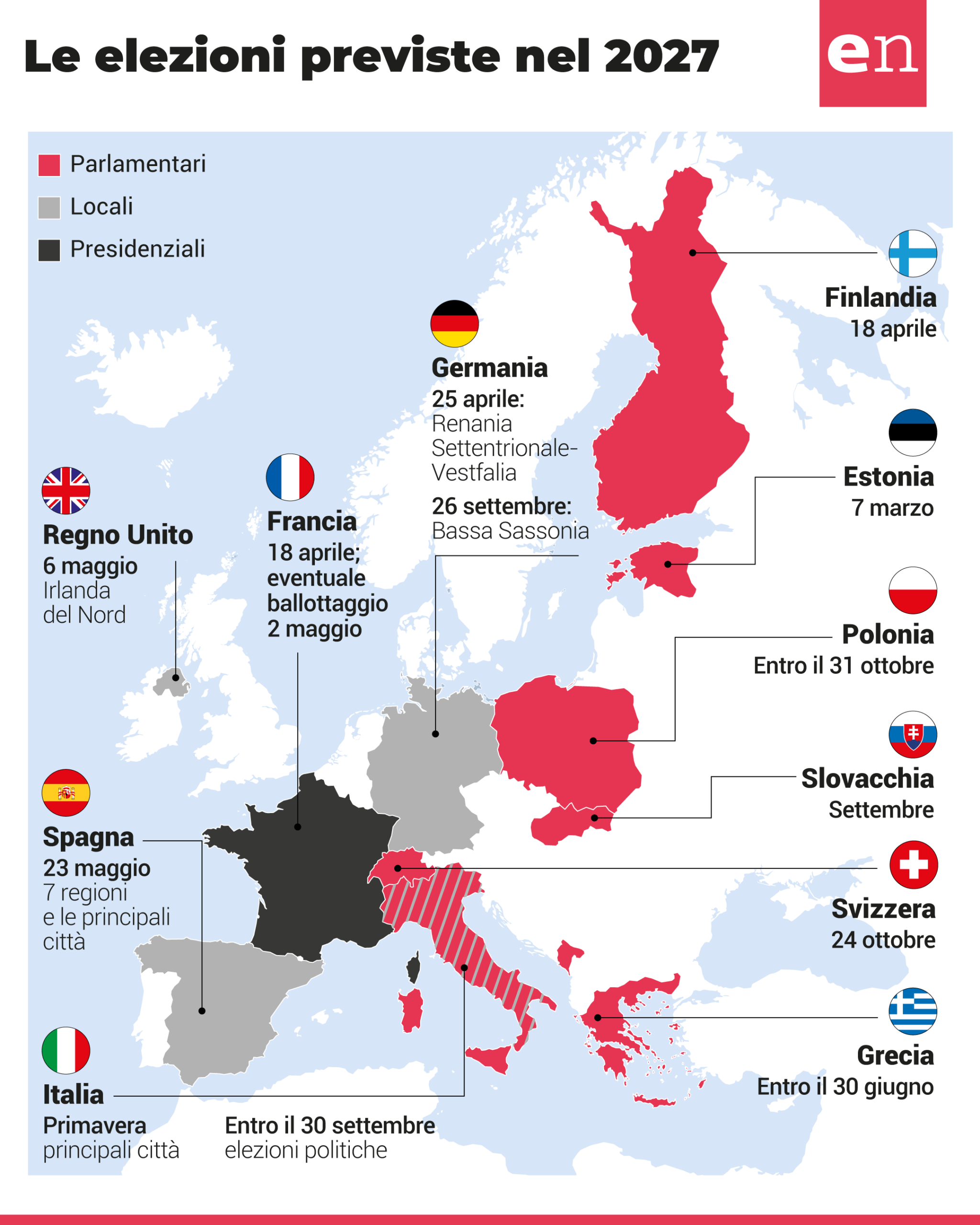
    Dopo Ungheria, Bulgaria, Cipro, Svezia e Lettonia: le elezioni nell’UE nel 2026

    di Redazione eunewsit
    17 Aprile 2026

    Il centrodestra ad aprile 2026 guida 13 governi su 27, ai quali si aggiungono tre governi di destra (come quello di Giorgia Meloni...

    La commissaria europea al Mediterraneo, Dubravka Šuica, presenta il Patto Mediterraneo Piano d'Azione (17 aprile 2026). Fonte: EC - Audiovisual Service

    Trasformare le sfide attuali in opportunità: l’UE presenta il piano d’azione per il Mediterraneo

    di Annachiara Magenta annacmag
    17 Aprile 2026

    La commissaria per il Mediterraneo Dubravka Šuica ha illustrato oggi i tre pilastri fondamentali: persone ed educazione, economia, sicurezza e...

    • Editoriali
    • Eventi
    • Opinioni
    • Risultati Europee 2024
    • Chi siamo
    • Contatti
    • Privacy Policy
    • Cookie policy

    Eunews è una testata giornalistica registrata
    Registro Stampa del Tribunale di Torino n° 27

    Copyright © 2025 - WITHUB S.p.a., Via Rubens 19 - 20148 Milano
    Partita IVA: 10067080969 - Numero di registrazione al ROC n.30628
    Capitale sociale interamente versato 50.000,00€

    No Result
    View All Result
    • it ITA
    • en ENG
    • Politica
    • Esteri
    • Economia
    • Cronaca
    • Difesa e Sicurezza
    • Salute
    • Agrifood
    • Altre sezioni
      • Cultura
      • Diritti
      • Energia
      • Green Economy
      • Gallery
      • Finanza e assicurazioni
      • Industria e Mercati
      • Media
      • Mobilità e logistica
      • Net & Tech
      • News
      • Opinioni
      • Sport
    • Editoriali
    • Podcast / L’Europa come non l’avete mai ascoltata
    • Report Draghi
    • Risultati Europee 2024
    • Eventi
    • Le Newsletter di Eunews

    No Result
    View All Result
    • it ITA
    • en ENG
    • Politica
    • Esteri
    • Economia
    • Cronaca
    • Difesa e Sicurezza
    • Salute
    • Agrifood
    • Altre sezioni
      • Cultura
      • Diritti
      • Energia
      • Green Economy
      • Gallery
      • Finanza e assicurazioni
      • Industria e Mercati
      • Media
      • Mobilità e logistica
      • Net & Tech
      • News
      • Opinioni
      • Sport
    • Editoriali
    • Podcast / L’Europa come non l’avete mai ascoltata
    • Report Draghi
    • Risultati Europee 2024
    • Eventi
    • Le Newsletter di Eunews

    Attenzione