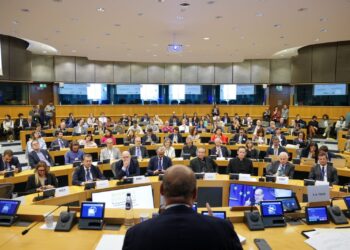
Lady Mogherini appeared assured as she submitted to the scrutiny of the European Parliament and has emerged unscathed from three hours of tight questioning that went from relations with Cuba to drug trafficking, from sexual minorities to climate change, passing by human rights and the European defence budget. The President of the Foreign Affairs Committee, Mr Elmar Brok, was visibly satisfied at the press conference that followed the hearing and said he was convinced Parliament would approve Mogherini’s nomination, given the admired applause that accompanied Mogherini as she left the Assembly.
What is this unknown and ‘too young and inexperienced’ Italian, as she has been described, likely to change in the EU foreign policy? Rumours in Brussels pointed to Mogherini’s candidature as a prestigious office rather than a substantive one, designed to keep Italy out of the competition for strategic portfolios like trade and economic and financial affairs. Yet the lady has shown that she knows her files and has demonstrated that she has leadership and vision. Asked about the US’ influence on the EU decision to apply sanctions to Russia, she has repeatedly stated that no matter how difficult, European decisions are taken autonomously by the 28 member states. Knowledgeable about the global balance of power, Mogherini has explained that the Union must put more effort into being appreciated as a strategic partner by emerging powers like India, Brazil and China. In the past, Lady Ashton seemed to consider the EU’s significance on the international stage rather obvious.
With Mogherini, European foreign policy (re)starts from the neighbourhood: the obsession with Eastern Europe and enlargement, heavily influenced by large member states like Poland, will be complemented by more attention to the South. Questioned on the Israeli-Palestinian conflict and events in the Middle East, Mogherini has underlined the importance of a regional approach where European diplomacy must revive relations with Arab countries and strengthen ties with positive models like Morocco and Tunisia. She sees the management of refugees’ fluxes affected by the crises in Iraq and Syria as a humanitarian imperative and Europe needs to do as much to manage crises as to prevent them. Mogherini stated that it is necessary to work on the long-term structural causes of population movements such as poverty and bad governance in the countries of origin, which exacerbate marginalization and provide the ground for extremist responses such as terrorism. Her reference to the persecution of Christians in the world (‘a situation that is not discussed enough’) has satisfied the conservative wing of the European parliament while she has emphasized that ISIL’s fundamentalism is a threat first and foremost, for Muslims of all origins.
Mogherini provided convincing answers on international law (‘which is the basis of all relationships with third countries’) and human rights (‘which are at the heart of European foreign policy’): reference to the work of the EU Special Representative for Human Rights could indicate a willingness to give substance to this office. Interestingly, she has referred repeatedly to the need to work with different actors including civil society (Mogherini has even apologized for naming it so often) not only as a source of information, but also as an operational partner and an agent of concrete initiatives.
The novelty with respect to Lady Ashton’s approach can be found both in the explicit answers and in the nuances of Mogherini’s statements and her choice of team. Favourable to the role of parliamentary diplomacy in the resolution and prevention of conflicts, Mogherini has made it clear that it must be based on a deep understanding of the objectives of EU foreign policy and on transparency of information between the institutions. Sensitive to inter-institutional dynamics, she has reassured Parliament that she will work to find a constructive and pragmatic solution to the problem of parliamentary access to intelligence and sensitive information. She has a firm conviction that the External Action Service is at the heart of European foreign policy and if confirmed, Mogherini expects all institutions, including Parliament, to work in synergy. The proposal of a ‘White Paper’ on the EEAS could give concrete substance to the articulation of inter-institutional relations focused on foreign policy. Intellectuals, think tanks and members of national parliaments will be amongst the actors consulted during her announced tour in the 28 European capitals to help member states develop a common vision for the Union’s foreign policy. Mogherini seems to have understood very well that her main allies, but also potential detractors, are the member states and sent reassuring signals.
We can expect greater attention to political dialogue. She gave exemplary answers on the crisis in Ukraine marked by firmness but open to opportunities with Russia (‘the sanctions are gradual and reversible. If the Minsk agreement was to be fully implemented we could consider reviving the political dialogue with Moscow ‘), as well as the need to ‘hear’ the Ukrainian leadership (‘ if the Ukrainians believe that a political solution is possible, we must support them because they are the first to be affected by the conflict ‘). On European security and defence policy, Mogherini stated that CSDP missions must not be a replacement for member states’ inactivity but must be the result of a shared strategic vision and common objectives. ‘I’m not naive’ she said, referring to member states’ bilateral defence initiatives, and indicated that under her leadership there will be respect for the role of each. She has admitted that the defence budget is a problem ‘everyone knows about’ and asked Parliament’s help to solve it, however she pointed out that economies of scale are necessary and the resources of the 28 member states must be pooled together in order to respond effectively to the crises that Europe faces.
Determined to play fully the role of vice-president of the European Commission, Mogherini will be helped by a head of cabinet that knows its corridors by heart and the institutional backing of the Italian Ministry of Foreign Affairs and its experts. She stressed that Europe’s credibility in foreign policy and particularly in relations with authoritarian regimes, is conditional on respect for human rights and fundamental freedoms within European countries: a clear reference to the close collaboration she intends to establish with the vice-president for fundamental rights and inter-institutional relations. She must, however, take into account reports by the European Court of Auditors that in recent years have heightened criticism of the financial management of the Commission’s initiatives, which do not seem to produce sustainable results.
Mogherini has made all the right noises and touched all the right chords. With her national experience as a Member of Parliament and as civil society activist, thorough and competent, she seems to have convinced the Assembly. The five years ahead will test her commitment, but the statements she made in Parliament remain a benchmark for measuring the progress of the Italian lady.
Marta Martinelli is Senior Policy Analyst for EU External Relations at the Open Society European Policy Institute. Here, she writes in her personal capacity. @marta2twitt
![[Copyright: European Union]](https://www.eunews.it/wp-content/uploads/2026/10/euco-261015-350x250.png)




![[Copyright: European Union]](https://www.eunews.it/wp-content/uploads/2026/10/euco-261015-120x86.png)